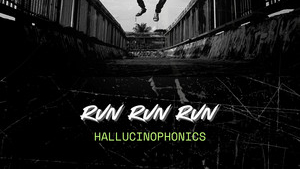
Hallucinophonics’ “Run Run Run” stands as a striking exploration of urban existential tension, blending indie urgency with a deeper psychological weight. From its opening moments, the track establishes itself as more than just a high-energy anthem; it becomes a reflection of modern life’s relentless pace. The music feels engineered to mirror motion itself, built on surging, engine-like rhythms that immediately evoke the sensation of being caught in an endless sprint through a dense, unforgiving cityscape. Beneath its kinetic surface lies a sense of unease, as though every beat is pushing forward while simultaneously trying to escape something invisible.
Instrumentally, the song thrives on contrast and transformation. Its soundscape oscillates between heat-soaked intensity and moments of fragile clarity, creating a sonic environment that feels alive and reactive. At its most charged, the arrangement pulses with industrial urgency, as though the city itself is breathing through distorted machinery. Then, without warning, it softens into crystalline, airy passages that feel suspended in time. This dynamic structure is essential to the track’s identity, reinforcing the idea that modern urban life is not a single experience but a constant fluctuation between overwhelm and reflection.
The vocal performance deepens this emotional duality with remarkable precision. The delivery shifts between intimate, near-whispered confessions and expansive, almost gospel-like surges of emotion. This oscillation creates the impression of a voice struggling to maintain composure while being pulled apart by its environment. There is exhaustion embedded within the performance, but also defiance, as if each phrase is an attempt to reclaim control over chaos. The result is a vocal presence that feels humanly fragile yet spiritually charged, grounding the song’s broader thematic ambitions in raw emotional texture.
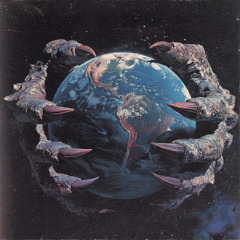
Lyrically, “Run Run Run” constructs a vivid portrait of urban entrapment disguised as motion. The writing leans into poetic imagery that is both surreal and grounded, with lines such as “The summer swallowed all the exits and the city grew its teeth at last” capturing a claustrophobic beauty. Characters like Sasha, who runs “like stolen footage,” and Marco, whose movement resembles a whispered confession, serve as symbolic extensions of the central theme. These figures do not simply move through the city; they embody its psychological pressure, revealing how escape often becomes another form of entanglement.
Ultimately, Hallucinophonics deliver a piece that transforms motion into metaphor. “Run Run Run” is not just about physical running but about the compulsion to outrun stagnation, memory, and emotional weight within an overwhelming environment. The song’s power lies in how it refuses resolution, instead circling the idea that constant movement may itself be a kind of paralysis. By the time it concludes, it leaves behind a lingering question rather than an answer, reinforcing its central truth: in a city that never stops moving, stillness can feel like the most unreachable destination.