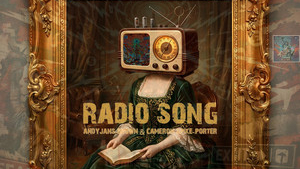
“Radio Song” by Andy Jans-Brown emerges as a sharp, intellectually charged critique of the modern digital landscape, balancing accessibility with conceptual depth. Built as both a sonic statement and a socio-political reflection, the track engages directly with the anxieties of hyper-connectivity and algorithm-driven life. Produced by Cameron Spike-Porter and carried vocally by Andy Jans-Brown, it positions itself not merely as entertainment but as an analytical response to how contemporary media environments shape perception, emotion, and attention.
From a production standpoint, the track thrives on contrast. Grant Gerathy’s steady, heartbeat-like drumming forms a grounded rhythmic core that feels distinctly human, almost bodily in its consistency. Around it, layered electronic textures introduce glitch-like instability, evoking the fragmented nature of digital consumption. This tension between organic rhythm and synthetic disruption becomes the song’s structural language, reinforcing its thematic concern with the collision between lived experience and mediated reality.
Andy Jans-Brown’s vocal delivery is central to the song’s impact, offering a performance that is measured rather than explosive. Instead of relying on aggression, he adopts a tone that feels observational and quietly defiant, which makes the lyrical critique more unsettling in its restraint. Lines such as “Ain’t life grand in this gas lit nation?” are delivered with controlled irony, highlighting the absurdities of digitally saturated existence without drifting into theatrical excess. This understated approach strengthens the song’s sense of realism and immediacy.
Lyrically, “Radio Song” draws heavily from ideas associated with Christopher Wylie’s Mindfck, particularly the notions of percepticide and algorithmic behavioural manipulation. It translates abstract psychological and political frameworks into lived emotional experience, describing a condition of being “caught in a ludic psychometric life” and continuously stimulated through engineered dopamine loops. Rather than presenting these ideas as distant theory, the song embeds them into a narrative of everyday mental fatigue and fractured attention, making its critique both intellectual and personal.
Ultimately, “Radio Song” succeeds because it refuses to separate message from musicality. It operates as both a protest against digital colonisation of attention and a deliberately engaging listening experience, driven by rhythm rather than despair. Its idea of a “rebellion of rhythm” becomes its defining principle, suggesting that resistance can exist not only in rejection but in conscious presence and reclaimed enjoyment. In doing so, the track positions itself as a thoughtful, groove-oriented anthem for navigating an increasingly manipulated media world.