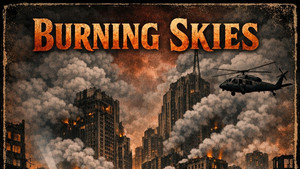
The Little Falls Band’s “Burning Skies” unfolds as a deeply immersive exercise in sonic minimalism and atmospheric tension. Across its extended runtime of over six minutes, the track resists conventional songwriting structure, instead building its identity through repetition, gradual evolution, and textural layering. Rather than relying on hooks or lyrical narrative, it constructs a mood driven experience that feels intentionally boundless, as though the listener is drifting through a slowly shifting sonic environment. The result is a piece that prioritizes sensation over story, inviting full absorption rather than passive listening.
At its core, the track’s instrumental foundation is built on a steady, almost ritualistic rhythmic pulse that anchors everything else. This repetition is not static but carefully modulated, with subtle variations in tone, density, and spatial placement keeping the arrangement alive. Electronic textures emerge like distant signals breaking through haze, while ambient drones stretch across the stereo field, creating a sense of vastness that feels both controlled and unstable. Each layer is introduced with restraint, reinforcing the impression that nothing in the composition is accidental, even when it feels organic or unstructured.
The production design deserves particular attention for its patience and precision. Instead of dramatic shifts or explosive climaxes, the track thrives on incremental transformation, allowing tension to accumulate almost imperceptibly. The soundscape often feels suspended between expansion and collapse, as though it could either dissolve into silence or erupt into intensity at any moment, yet it chooses neither. This balance between restraint and pressure gives the track its hypnotic quality, drawing the listener deeper into its cyclical motion with each passing minute.
Vocally, the performance is deliberately understated, functioning less as a lead narrative force and more as an additional rhythmic and textural element. Jonathan Richard Wing’s vocal blend seamlessly into the sonic fabric, often blurring the line between human expression and synthetic processing. The voice is not just used to convey traditional lyrical storytelling or emotional peaks. Instead, it reinforces the atmosphere, becoming another layer in the dense, immersive architecture of the track. This choice strengthens the overall cohesion of the piece, ensuring that no single element disrupts its unified mood.
Ultimately, “Burning Skies” stands as a striking example of controlled artistic restraint and atmospheric composition. It succeeds not by demanding attention through conventional means, but by slowly enveloping the listener until the boundaries between sound, space, and perception begin to blur. The Little Falls Band and Jonathan Richard Wing craft a work that feels less like a song and more like an environment, one that lingers long after it ends, echoing with the same restrained intensity with which it begins.